It Took Three Years and Two Failures to Get My Team Using AI
There’s a lot being written about building AI tools right now, but it often glosses over the part that actually matters: whether people use them.
I’ve spent over three years integrating AI into a creative content operation. My first two attempts failed, and not because the tools themselves were broken.
Rather, we were tackling the problem with the completely wrong approach.
The First Attempt
When it became obvious that AI was going to be an order-of-magnitude change in how we work, I wanted to be involved as fast as possible.
So in early 2023, I started experimenting with AI to research and write full articles for my company’s site. It was decent, but it was clunky to use, and the text itself was repetitive and obviously AI-generated (even more so then than now). We had a couple of early successes so we tested it fairly aggressively, but when the results weren’t coming in as readily as we’d hoped, the organization largely fizzled on using it for content operations.
But by that point, people had already made their first impression of AI content, and it wasn’t good. I work with a lot of creative people, and the flat, repetitive nature of those early AI days just confirmed everything they feared: that AI might suck the creativity out of the work. That reaction is completely understandable, and it isn’t irrational either. But it meant that over the next two years, I was trying to introduce AI to an audience who had already seen it be bad.
The Second Attempt
In 2024, AI image generation got so good that using it in production became a viable option. This was particularly important for us, as a lot of what we cover doesn’t have good imagery available (historical subjects, spooky stuff, and so on). AI-generated images filled a real hole that stock photos and screenshots couldn’t.
So I generated some images myself and put them on real content. And when they performed well, I took that to leadership to make the case that we should get a Midjourney account for the team. I got it approved, and I even built out tutorials on how to use it — best practices, plus clear examples of how it had already been used for successful content.
And yet almost nobody used it.
Initially, I thought it was just because Midjourney was clunky. (To this day it still requires you to work through a wonky Discord interface.) But eventually we got Nano Banana image generation for everyone through our Google Workspace accounts — much easier, essentially the chatbot interface everyone had already gotten used to by then.
And they still barely used it.
I didn’t understand. Why were people not using a tool that was obviously capable of producing successful content? And why were they still so averse to AI despite its clear benefits?
It wasn’t until the third attempt that the answer became clear.
The Third Attempt
In 2025, Claude Code released and changed everything. Where before it took multiple layers of approval and many engineering hours to get a tool built, I could now just describe what I wanted and, over many iterations, build exactly what our team needed.
As it turns out, that was exactly what I needed to advance AI adoption at scale.
I started building tools that mirrored our existing workflows in a way that was better, faster, and cheaper. The most notable of these was FrameShop — a Photoshop replacement built directly into our internal tool suite.
Here’s the part I didn’t fully appreciate at the time: FrameShop wasn’t an AI pitch. It was just a faster way to do work people were already doing every day, and because they were already comfortable with Photoshop, switching didn’t take much convincing. But it gave me something I’d never had before — a surface my team opened every single day that I could build into.
FrameShop became the standard way to create social posts across the team. And little by little, I added AI features that solved real problems people were actually having: applying a filter that’s annoying to do by hand, expanding an image that’s framed too tight, removing an unwanted item from a photo. These were everyday problems, and AI offered quick, obvious solutions to them. As people got comfortable with those, their adverse relationship with AI slowly started to melt away.
Eventually I went for the home run and added AI text generation — the same category of feature that had repulsed the team a couple of years earlier. But I was careful about how I integrated it.
For starters, I made it as easy as clicking a button. One click, and the tool gathers all the relevant context into a pre-designed prompt, so the user doesn’t have to think about anything else. No new tab, no explaining the brand from scratch, no prompt engineering.
More importantly, these features were always presented as suggestions. Never mandatory, and never positioned as better than what the user might come up with on their own. Users could edit anything the AI produced or reject it outright.
Those AI-generated text options went on to be successful, both in performance and in adoption. They showed up on a lot of winning posts, but they also helped stir up completely original ideas from the team — ideas that wouldn’t have surfaced otherwise. From there I kept building: NSFW checks, spelling and grammar checks, rewrite suggestions, all designed around real problems the team was running into.
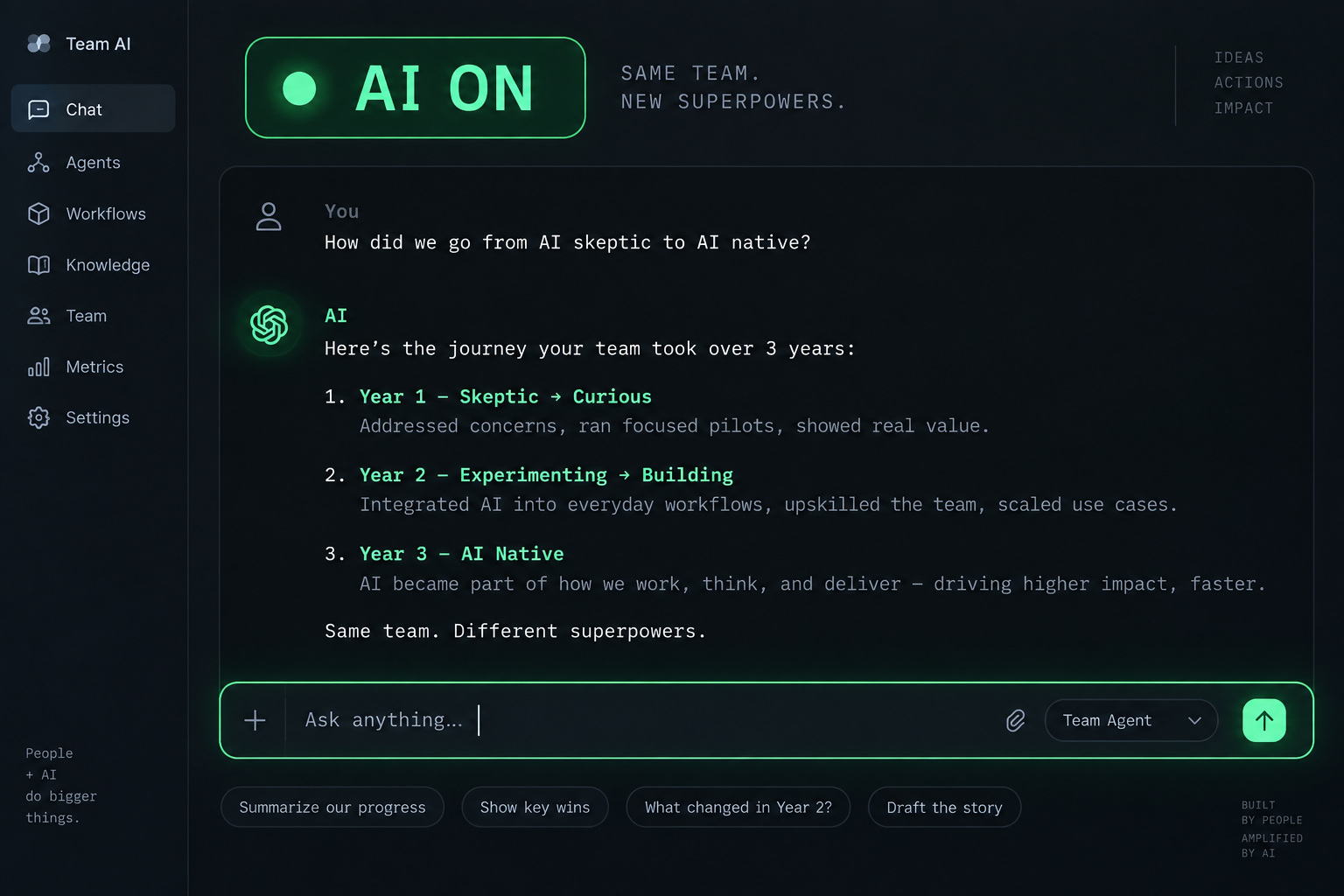
Three years ago, the number of people at my company using AI in their daily work was one: me. It grew to fourteen people on my team, working in a suite of AI-powered tools I built. And most importantly, they’re excited to use them.
What Actually Unblocked The Team
Looking back, there are a few things I can point to that turned my team from AI skeptics into AI optimists.
1) Make sure the AI is solving a real problem
So much of the discourse around AI right now is that it’s a solution in search of a problem. To solve this, you must first understand the problem you’re trying to solve, and only then decide whether AI is the right tool for it.
I started this whole journey with general excitement about AI and tried to use it on problems it wasn’t capable of solving. Once I got clearer about which of our problems AI could actually solve, building things people wanted to use got much easier.
I recently got this wrong by building a conversational agent into our image tools — you describe an edit in plain language and it makes the edit. It works fine. Almost nobody uses it, including me, because for most of what it does a person with a mouse is simply faster. Describing a crop takes longer than doing the crop.
There’s a long list of things AI is dramatically better and faster at. There’s also a long list of things a human is better and faster at, and that second list didn’t get shorter just because the first one got longer. That feature wasn’t solving a real problem. It was solving a problem I thought was cool.
2) Make using it as simple as possible
People are resistant to change. There’s no getting around that. So the goal is to make it as easy as possible for them to dip a toe in.
For us that meant baking AI directly into the tools the team was already using every day, and making it as simple as clicking a button. This is also the answer to the question I couldn’t figure out during the Midjourney era: the problem was never that the tool was hard. It was that the tool lived somewhere else. Even the easiest tool in the world loses to a button that’s already in front of you.
3) Make the wins visible
The more people see success stories, the more they want to replicate the strategies behind them. So it’s critical to make AI-enabled wins clear and visible, and to talk openly about how AI was used to get there.
I’d add one thing: show the misses too. A single good AI output proves nothing, because everyone assumes you cherry-picked it. A good one sitting next to the five that failed proves the actual point — that human judgment is still doing the work.
4) Always give humans the final say
Creative people don’t want to be handed a verdict, but they’ll happily take a head start. So when you’re building AI tools for creatives, always give them the option to edit — or flat-out reject — what the AI suggests.
The way I frame it to my team: let AI do the first 80%, which is usually the boring, tedious part nobody wants to do, so we can spend our attention on the last 20% — which is what actually makes or breaks the finished product.
Final Thoughts
AI isn’t going away, and neither is the resistance to it. But I’ve stopped treating that resistance as the problem to solve. Most of it is a reasonable response to being handed a tool that doesn’t fit the work.
Fix the fit, put it where the work already happens, and leave the final call with the person doing the job. The resistance mostly takes care of itself after that.
The tools were the easy part; getting people to want them was the work. But once you solve that, it opens up a world of possibilities for your team.